

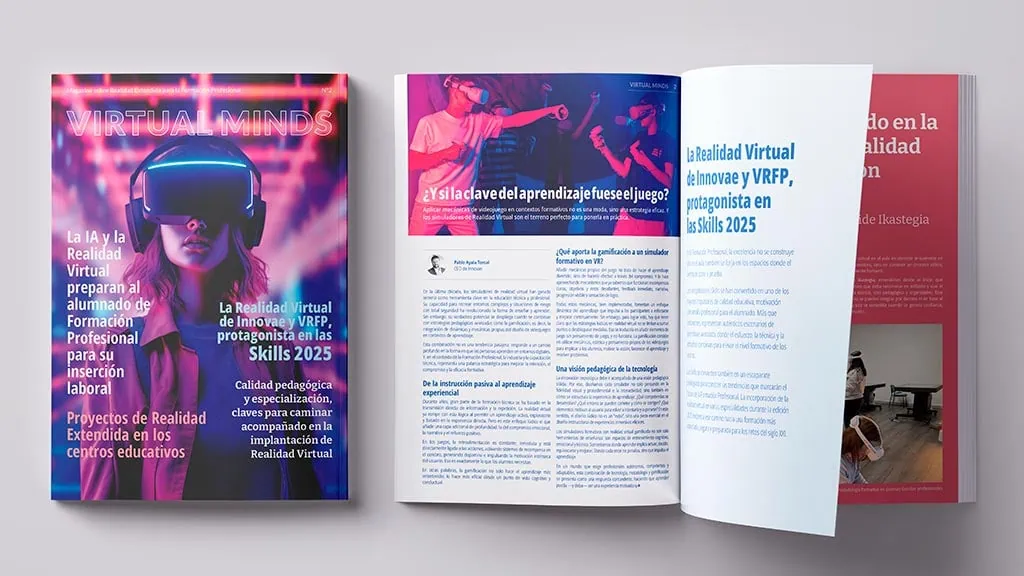
Educational innovation is not driven by technology alone. It is driven by the people who bring technology into the classroom, put it into practice, adapt it to real needs and turn it into a meaningful tool for better teaching.
That idea is at the heart of the second issue of Virtual Minds, our magazine on Extended Reality for Vocational Education and Training.
This new edition features real implementation experiences from educational institutions and shares the perspectives of teachers, organisations and professionals who are already integrating virtual reality, mixed reality and artificial intelligence into practical learning.
All with one clear goal: to better prepare students for their professional future.
Virtual Reality enters the Skills competition arena
One of the central themes of this edition is the Skills competitions, where virtual reality has taken on a significant role across a range of regions and professional disciplines. These competitions are not only a test of technical expertise; they also serve as a platform for identifying and demonstrating new trends that may influence the future development of Vocational Education and Training.
Here, Empar Agueda i Solanes, Skill Expert for Skill 52 Chemical Laboratory Technology at CV Skills; Jesús Vázquez, Transport and Logistics Area Coordinator at CyL Skills; and Fernando Alfageme, Technical Coordinator for Renewable Energy at CyL Skills, share first-hand experiences of using our simulators in competition settings.
Their testimonials underline how these tools can bring innovation, flexibility and greater fairness to Skills assessment, while also opening up new possibilities for technical training more generally.
AI, Virtual Reality and Employability
Another of the standout projects featured in this issue is SIMUJOB, an initiative that combines virtual reality and generative artificial intelligence to help students prepare for real job interviews with greater confidence.
The project is the result of a collaboration with con Campus Digital FP, Centro Formación Somorrostro, CIFP Usurbil, IES Alfonso VIII y Avansel. In the magazine, Miguel Aparicio, Director of Campus Digital FP Aragón, explains how the initiative addresses a clear educational need: strengthening soft skills such as communication, self-confidence and the ability to manage pressure.
Mixed Reality for inclusive employment
The second edition of Virtual Minds also explores a project with a significant social impact: the collaboration between CIFP Miguel Altuna LHII and Gureak Lanean to use digitalised procedures as a tool for supporting inclusive employment.
Joseba Zabala, Director of Innovation and lecturer at CIFP Miguel Altuna LHII, and Julen Pascual Delgado, Plant Manager at Gureak Lanean, explain how SAAM, our mixed reality platform for digitalising technical operations, has made it easier to adapt workstations to the needs of people who require additional support.
Implementing VR with a clear pedagogical purpose
Introducing virtual reality into an educational institution is not simply about having access to good simulators. It also requires support, methodology, teacher training and a clear vision of how technology should be integrated into the classroom.
This is one of the central ideas explored by Raúl Setién, Director of Innovation at Calasanz Lanbide Ikastegia, who shares the institution’s experience of gradually introducing virtual reality simulators across a range of vocational disciplines.
His perspective is especially valuable because it places people at the heart of the process: addressing concerns, building confidence, supporting teachers and creating a sustainable model for adoption. It is a reminder that technology delivers real value only when it is integrated with a clear educational purpose.
Interactive virtual environments in Vocational Education and Training
In this context, collaborative virtual reality has enabled students to visualise complex equipment, practise procedures and understand connections before working with the physical equipment, strengthening their preparation ahead of the competition.
The edition also includes the experience of CIFP Escuela Agraria Derio, where Aitor Nieves, Head of the Landscaping and Rural Environment Department, describes how ERAVIS is transforming landscaping education through immersive environments, tailored 3D content and greater autonomy for teaching staff with ERAVIS Lab.
Building simulators from real classroom needs
Working closely with educational institutions is essential when developing training simulators that respond to real teaching and learning needs. One example is our Paint and Coatings Application simulator, developed in collaboration with Institut Pere Martell and Centro Formativo Otxarkoaga.
For Roberto Perea, Vehicle Painting teacher and Active Methodologies Coordinator at Institut Pere Martell in Tarragona, the starting point was clear: virtual reality should do more than reproduce existing workshop activities. Its real potential lies in providing learning opportunities where traditional practical training is constrained.
Bringing VET, industry and technology together
Another example of this collaborative approach is the Electric Vehicle training simulator, developed with CESVIMAP and four Vocational Education and Training institutions: IES Jorge Manrique, CIFP Río Tormes, CIFP Juan de Herrera and IES Luis Vives.
Through the perspectives of Irene Lastras, Head of Department at CESVIMAP, and Beatriz Jiménez, Project Coordinator and teacher at CIFP Juan de Herrera, the article highlights the value of combining specialised technical knowledge, teaching experience and technological development to create a training tool aligned with the needs of both the education sector and the automotive industry.
Educational institutions already integrating Extended Reality into everyday learning
This edition of Virtual Minds closes with success stories from institutions that have already incorporated virtual and augmented reality into their teaching methodology. This section features Andrés Mayos, Deputy Director at Escola Ramón y Cajal; Juan de la Cruz Muñoz Escobar, Head of the Electrical/Electronics Department at IES Juan de la Cierva; David Saura, Director of Communications and Promotion and Coordinator at Institut Escola del Treball de Lleida; Jordi Sora i Domenjó, Director of Institut La Bastida; Montse Pérez, Quality Coordinator and Head of the Sociocultural and Community Services Department at INS Guillem Berguedà; Silvia López, Head of VET Studies at IES Rey Don García; and Josu Ozkorta, Digital Learning Specialist at CIFP Armeria Eskola LHII.
Together, their testimonials show how Extended Reality is moving beyond experimentation and becoming a practical educational tool: one that supports safer training, increases student engagement and brings learning closer to the realities of the workplace.
With this second issue of Virtual Minds, we want to celebrate the work of the educational institutions, teachers and organisations that are helping shape the future of Vocational Education and Training. Because meaningful transformation does not happen by itself: it is driven by people who choose to innovate, share their knowledge and lead change.