

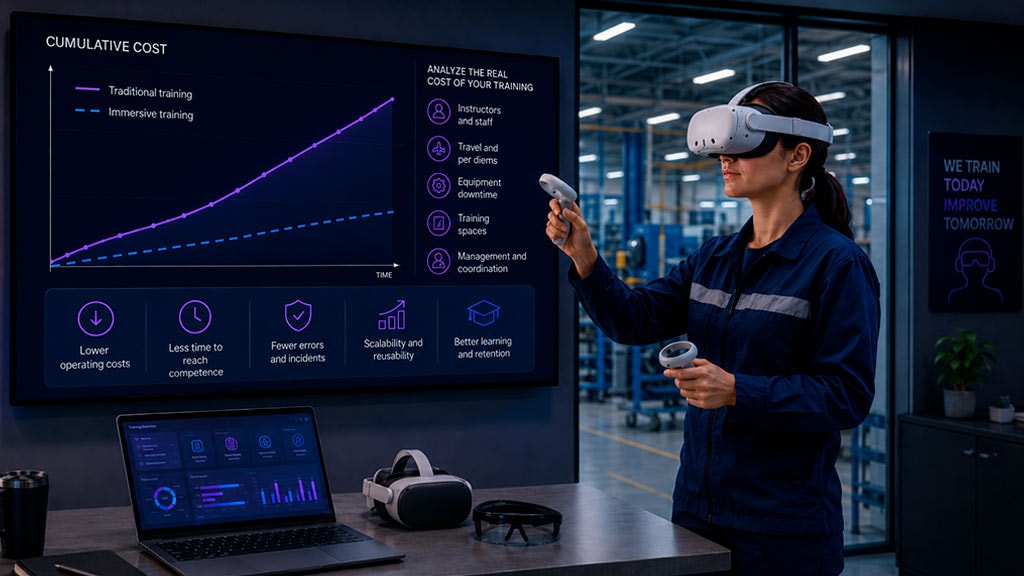
Before we can determine whether VR training delivers a worthwhile return on investment, there’s one fundamental question to answer: what is the real cost of training each employee?
The figure is often harder to calculate than it might seem. Traditional training costs are rarely concentrated in one place. HR covers part of the budget, Production deals with downtime, and Administration manages travel, facilities and materials.
Individually, these expenses may not seem particularly high. But when added together, the true cost of training can be considerably higher than expected. This is why measuring the ROI of immersive training isn’t simply a matter of comparing the cost of VR software and headsets with that of a face-to-face session. It requires a broader view of the entire training process and its associated costs.
Understanding the real cost of traditional training
To establish this baseline, we need to identify at least five key components of traditional training costs.
1. Instructor and specialist staff hours
The cost of an instructor goes well beyond the hours spent delivering training. Preparing materials, organising practical activities, assessing participants and providing support all take time.
And when experienced technical employees are responsible for training others, there’s an additional factor to consider: the time they spend teaching is time taken away from their regular work.
2. Travel expenses
When employees need to travel to a central training facility, each new training session brings additional costs for transport, accommodation and meals.
3. Equipment and facility downtime
Traditionally, certain skills can only be practised using real machinery, vehicles, tools or production lines. In these cases, companies must account not only for the cost of training itself, but also for the production lost while equipment or facilities are being used for training.
4. Training spaces and facilities
The cost of dedicated training rooms, rented spaces, utilities, maintenance and facilities that remain underused between training sessions must also be considered.
In some cases, training requires specially equipped facilities, adding even further to the overall expense.
5. Management and coordination
Scheduling sessions, inviting participants, preparing materials, printing documents, managing bookings and recording results all require time and resources.
Although these administrative tasks may seem minor individually, their cumulative impact over the course of a year can account for a significant proportion of total training costs.
Once all these expenses have been added together, we can calculate the annual cost of training and divide it by the number of participants. This gives us a fundamental starting point: the true cost per employee trained.
What changes with virtual reality training?
Unlike traditional training, VR training requires most of its investment upfront. This typically includes developing or purchasing training content, acquiring VR headsets, training users and integrating the technology into existing business systems and processes.
After the initial setup, ongoing expenses are usually limited to software licences, updates, support and replacing hardware when necessary. And here’s where the benefits become clear: as more employees are trained using the same solution, the average cost per participant falls. The longer the solution is used, the greater the potential savings.
To measure these savings, businesses need to compare the annual cost of their traditional training model with the total cost of their VR training solution.
1. Direct cost savings
Virtual reality can help reduce travel expenses, accommodation and meal costs, instructor hours, material consumption and the time spent using real equipment for training.
While these costs may not disappear entirely, they can be significantly reduced.
2. Getting employees up to speed faster
The longer it takes a new employee to reach the required level of productivity, the greater the cost to the business.
VR helps shorten this learning process by allowing employees to repeat tasks, practise unusual situations and receive instant feedback on mistakes. They can build their skills through repeated practice before taking on responsibilities independently.
For businesses with high recruitment volumes, even a small improvement in time to competency can deliver considerable financial benefits.
3. Error prevention
In industrial and other high-risk environments, operational mistakes can result in equipment damage, production interruptions, rework, workplace accidents and potential legal liabilities.
VR enables employees to practise critical procedures and high-risk scenarios in controlled environments, without the costs or risks associated with recreating those situations in real-world conditions.
Potential savings can be estimated by analysing historical incident rates, average incident costs and any measurable reduction following the introduction of immersive training. In some operational contexts, preventing a single major incident may offset a substantial share of the initial investment.
4. Scalability
Traditional training often involves repeating many of the same expenses every time a new group needs to be trained. VR works differently. Once an immersive scenario has been developed, it can be used with multiple groups of employees, across different sites and over several years.
As more people are trained using the same solution, the initial investment is spread further, bringing down the average cost per participant over time.
Measuring learning effectiveness and skills retention
Assessing the ROI of training requires more than tracking course completion rates or assessment scores. While these indicators provide useful information, they do not demonstrate whether employees can perform procedures correctly or maintain their competence over time.
Hermann Ebbinghaus’s forgetting curve illustrates how quickly information can fade when it isn’t reinforced or applied. Experiential learning helps address this challenge by encouraging active involvement, practical experience and repeated practice.
VR training also provides a clearer picture of how employees are progressing. By tracking metrics such as task completion times, mistakes, missed steps and performance improvements across sessions, organisations can gain valuable insights into how effectively skills are being developed.
This gives organisations something far more useful than an estimate of training effectiveness: concrete data showing how employees are actually performing.
When companies combine this information with a clear understanding of training costs and operational results, VR training stops being a difficult expense to justify and becomes an investment whose value can be measured, demonstrated and increased over time.