

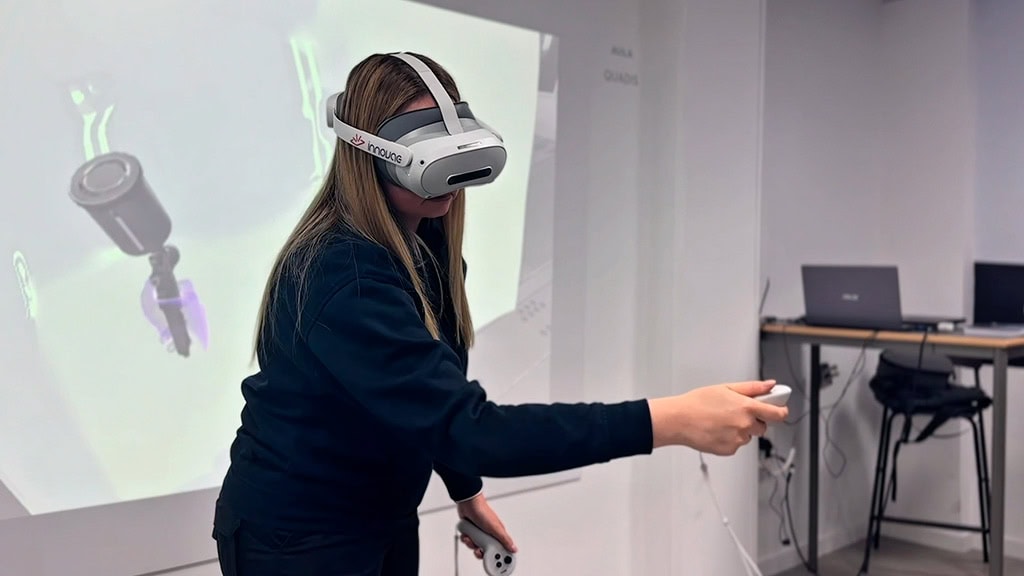
Located in Barcelona, Monlau Vocational Training School is recognized as a benchmark institution in automotive education in Spain. Its teaching approach is firmly rooted in practice, aiming to mirror real workshop environments and prepare students for the demands of the industry.
Students gain hands-on experience in tasks such as mixing paint, using personal protective equipment, setting up spray guns, and painting vehicle parts like bumpers, doors, and fenders.
While working with real materials and equipment is essential, it also presents challenges in terms of costs, resource consumption, and sustainability.
A partnership to advance training through immersive technology
As part of its commitment to innovation and alignment with industry needs, Monlau has taken a new step forward by signing a collaboration agreement to integrate virtual reality into its training model. This initiative represents a turning point in how future professionals are prepared.
With our VR Paint and Coat Application simulator, students experience the full painting process in a highly realistic environment. From mixing colors to configuring the spray gun and applying coatings on different vehicle parts, every step is practiced with precision, considering key variables such as distance, angle, and speed.
More practice time, lower costs, and greater sustainability
As Carlos Salazar, Head of Automotive Studies, explains, this solution brings multiple benefits: “When we started working with Innovae, our goal was to find a way to increase the number of hours dedicated to painting without facing some of the current challenges, mainly the associated costs and responsible use of materials.”
On one hand, the simulator allows students to train in a completely safe environment, with no exposure to chemicals or risks linked to improper use of equipment. On the other, it creates a controlled learning space where students can repeat exercises as many times as needed, make mistakes without material consequences, and receive immediate feedback to improve.
In addition, the simulator supports a more sustainable and efficient training model, reducing the consumption of paint and materials during the early stages of learning. This allows students to enter the real workshop with a stronger technical foundation, optimizing hands-on training time and improving the use of institutional resources.
An immersive experience that inspires students
For students, the VR simulator has become a truly engaging learning experience. “It feels like you’re actually painting,” says Alan González, who also points out its practical value: “It shows you the angle, how to handle the spray gun… everything. It’s one of the best learning experiences I’ve had.”
Lidia Patarro, another student in the same program, emphasizes the realism of the experience: “We selected and mixed the colors just like in real life, and then used a virtual booth to paint the hood.”
Beyond technical skills, these immersive experiences help students gain confidence, stay motivated, and feel more connected to their future profession.
Shaping the next generation of professionals
The partnership between Monlau and Innovae shows how technology can be meaningfully embedded into vocational training, enhancing practical learning instead of replacing it.
Virtual Reality becomes a strategic tool that extends training hours, reduces associated costs, enables more personalized learning, and prepares students to face real professional environments with greater confidence and precision.