

Augmented Reality
What is Augmented Reality?
Augmented Reality is a technology that overlays digital graphics and information onto the real world.
This experience is delivered through devices such as smartphones or AR glasses, which add virtual content to what the user is already seeing.
When using a smartphone, the AR experience appears on the screen, enhancing the live video captured by the camera.
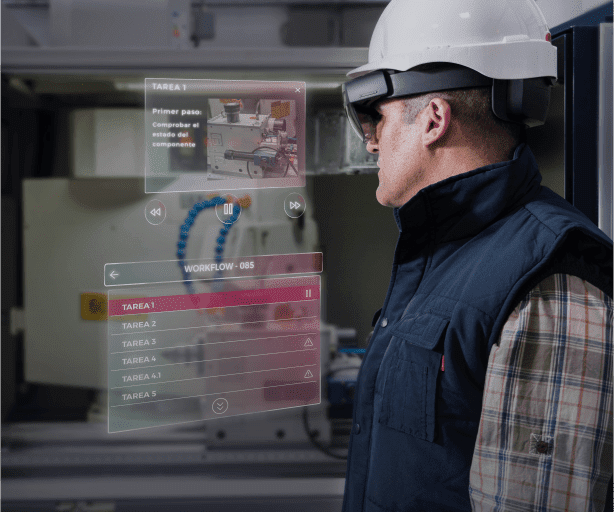
With Augmented Reality glasses, digital elements are projected directly onto the lens, creating an effect that feels very similar to viewing a hologram.

History of Augmented Reality
The origins of Augmented Reality are surprisingly old. The concept first appeared in 1901, when writer L. Frank Baum imagined a pair of electronic glasses capable of showing additional information about the people in front of the wearer.
The first technological attempt at an AR-like experience came in 1957. Cinematographer Morton Heilig created the Sensorama, a multisensory machine that combined visuals, sound, and even scent—marking the early foundations of what would later become Augmented Reality.
In 1973, computer artist Myron W. Krueger built one of the first interactive environments using cameras and projection systems to respond to users’ movements, creating an early form of mixed reality.
Throughout the 1990s, Augmented Reality began finding practical applications in fields such as industry and design. One of the most notable milestones came from Tom Caudell, who coined the term “Augmented Reality” to describe a system built to assist with complex electrical wiring tasks.
Although the idea emerged many decades ago, Augmented Reality remains an evolving technology. Only recent advances in computing and visualization have allowed AR to mature, enabling today’s AR companies to harness its enormous potential across multiple industries.
We specialize in building Augmented Reality solutions for enterprise and education. Ready to Bring Your Ideas to Life?
We offer a range of AR solutions that can be tailored to fit your projects and specific needs.
How does Augmented Reality work?
Augmented Reality is the combination of two technologies, machine vision and graphic engines.

Rendering Engine
The rendering engine is responsible for generating the visual content, typically 3D elements, displayed in an Augmented Reality experience. Computer vision algorithms ensure that these augmented elements are correctly positioned within the real-world scene, creating a coherent and believable composition for the user.
At the core of the graphics pipeline is the rendering process itself. This involves converting a three-dimensional scene into a two-dimensional image.
To produce the final render, the system processes several components: the 3D model’s geometry, surface properties (such as color and material), scene lighting, and the camera’s position.
Computer Vision
The computer vision techniques used in Augmented Reality are diverse and are generally referred to as tracking technologies. There are many types of tracking, for example, facial tracking, which detects and follows the position of a face, or texture tracking, which maps a reference image into a 3D coordinate system. More advanced methods now incorporate active sensors such as structured light, SLAM tracking, or full 3D tracking.
For an AR experience to feel seamless, everything must run in real time. This means both major components, rendering and tracking, need to operate at high speed and with great efficiency. Typically, the rendering module must generate around 60 frames per second, while the tracking module must process and interpret 60 frames per second as well.

Types of Augmented Reality
Depending on the device used to deliver the AR experience, Augmented Reality can be classified into three main types.
Augmented Reality on personal computers

Around 2006, driven largely by developments in the gaming industry, personal computers began incorporating more powerful processors and dedicated graphics cards. This made developing high-quality Augmented Reality experiences at an accessible cost possible for the first time.
During those early years, AR applications became especially popular in marketing: at points of sale, in events and roadshows, and even embedded directly into websites. Advertising campaigns leveraged the “wow effect” of this emerging technology to launch products and invite users to experience the blend of digital and physical worlds.
Augmented Reality on smartphone and tablet
The social and technological revolution sparked by smartphones acted as a catalyst for the growth of augmented reality. Smartphones, and later tablets as well, allowed users to enjoy augmented reality experiences very easily and anywhere. By 2009–2010, smartphones had sufficient computational power to run advanced AR applications.
AR quickly found applications in magazines, catalogs, and advertising campaigns. Other applications emerged in sectors like tourism, overlaying city information onto the smartphone camera view based on the user’s location and orientation, thanks to geolocation and built-in sensors. Companies also explored AR for training and entertainment, creating the first AR video games and interactive augmented manuals.

Augmented Reality headsets and smart glasses

Google Glass, released in 2012, was the first AR headset to capture widespread attention. Although it didn’t succeed commercially, it made the world realize that AR’s future lay in wearable glasses.
Around the same time, Epson released the Moverio BT-100, one of the first “see-through” AR glasses. It featured micro-projectors that allowed users to view both the real world and virtual content projected onto the lens simultaneously.
In 2016, Microsoft launched the HoloLens 1, a complete AR computing platform. This device integrated multiple sensors and technologies to recognize the environment, voice commands, and user gestures, significantly enhancing the user experience. HoloLens introduced the concept of “mixed reality,” which differs from traditional AR mainly in its ability to intelligently position virtual elements within the real world using a live 3D model of the environment.
Since then, devices like Magic Leap, HoloLens 2, and Nreal have proven the sector’s potential. Key challenges ahead include reducing costs for mainstream adoption and creating applications that fully exploit these devices’ capabilities to enhance everyday life.
At Innovae we deliver two AR-based solutions that support technical operations through guided processes and remote assistance, demonstrating practical applications of this technology in professional environments.
Your Trusted Partner in Augmented Reality Innovation. How Can We Help?
For over 20 years, we’ve helped industrial workers perform more efficiently, enhanced learning outcomes in education, and brought technological innovation to marketing and sales campaigns.
Differences between Virtual Reality and Augmented Reality
With the rise of Augmented Reality headsets, it has become easier to mix up these two technologies. The main difference lies in the level of immersion each experience provides.
Virtual Reality offers full immersion: all sensations perceived by the user are computer-generated. Users are fully transported into the digital world.
Augmented Reality on the other hand, enhances the real world by overlaying information onto it. Users stay aware of their environment, making AR ideal for applications where safety and context are important.

The application of VR and AR differ significantly, mainly due to the level of immersion each technology provides.
In theory, augmented reality will have a much greater projection than virtual reality, since it can be incorporated into any area of our lives, as it is a technology that enriches experiences and processes.
Virtual reality, by contrast, simulates experiences in a controlled environment. Its adoption often requires more radical changes in habits or workflows, as users must fully immerse themselves in a virtual world.
Main benefits of Augmented Reality
Augmented reality provides users with an improved interface to access information or services..
It allows users to access the information they need anywhere and hands free.

Quick access to information when visual patterns that have been calibrated are detected.

High quality 3D content and animation integrated in real space.

Multimodal user interfaces, allowing interaction via gestures and voice.

Sensitive to the environment and location, allowing content to adapt as the user moves.

Enhances everyday activities by providing useful, context-aware information at any moment.
Looking for Augmented Reality solutions? Let us help you bring your projects to life.
We offer a range of AR solutions tailored to fit your projects and specific needs.
.
Augmented Reality Use Cases
Augmented reality has a wide range of applications and can be leveraged in nearly any context to enhance outcomes.
Here are some examples of how AR is being used today.
Marketing

Print advertising and in-store promotions are still widely used by brands today. A common AR application is enhancing these ads through a mobile app available in app stores. Through the app users can access additional content such as videos or 3D animations, discounts, gifts or similar.
AR can also be applied directly to products. For example, in a car dealership, users could see extra information overlaid on each vehicle, showing optional features or hidden engine components.
Augmented catalogs are also common in marketing applications, helping users better understand how a product works, how to assemble it, or how it fits into a larger system.
Training
There are many ways to use augmented reality to enhance training.
Usually, we need to consult a paper manual while manipulating physical elements, for example, when assembling a piece of furniture or when operating a machine.
In these cases, Augmented Reality headsets offer huge potential, allowing hands-free operation while displaying information exactly where it´s needed, or even overlaid on the object being worked on.

Education

Augmented Reality transforms traditional textbooks into interactive 3D experiences for subjects like anatomy, chemistry or history.
Adding 3D content to educational materials makes concepts easier to understand.
AR also provides students with an interactive learning environment. The ability to manipulate 3D elements and explore scenes makes learning engaging and helps improve motivation and learning pace.
Industry 4.0
The manufacturing industry has been one of the earliest adopters of augmented reality.
Applications in areas such as maintenance, assembly support or quality control are already common in the industrial world.
The main uses of this technology involve step-by-step guided procedures that show operators how to assemble or repair equipment, as well as remote assistance systems that allow experts to resolve issues more effectively using AR-based instructions overlaid on the objects being worked on.

Medicine

One of the most powerful aspects of augmented reality is the ability to show things that are invisible to the naked eye. In the medical field, this has countless applications.
A key advantage of AR glasses in surgical environments is hands-free control through voice and gestures, preserving the essential sterilization of the operating room.
Unlock the potential of Augmented Reality for your business!
Contact our experts now to explore tailored solutions.