


While companies operate with large-scale machinery, complex facilities and industrial environments that require high standards of safety and training, many vocational training centres face the challenge of faithfully transferring this reality to the classroom.
This is not a question of a lack of willingness to provide training, but rather of physical, economic and logistical limitations: large equipment that cannot be installed in an educational centre, high investments that exceed their budgetary possibilities, or operational risks that prevent students in training from operating certain machines.
This natural gap between the industrial context and the training environment creates room for improvement in the practical preparation of students. Although they enter the labour market with a good theoretical foundation, they have not always had the opportunity to experiment directly with the equipment they will later have to work with.
Improving this alignment by providing learning environments that accurately represent the industrial context becomes a key opportunity to strengthen the connection between training and employment and ensure the competitiveness of the productive fabric.
Bringing the factory into the classroom without having the factory in the classroom
Contact with environments and procedures close to professional reality increases students’ interest and reinforces their commitment to training. By visualising and experiencing the tasks of the trade first-hand, their motivation, understanding of the purpose of their learning and consolidation of technical vocations increase.
Given this reality, virtual reality presents itself as an effective and accessible solution for bringing work processes and environments into the classroom that, in practice, would be too costly, bulky or risky to install and use in an educational centre.
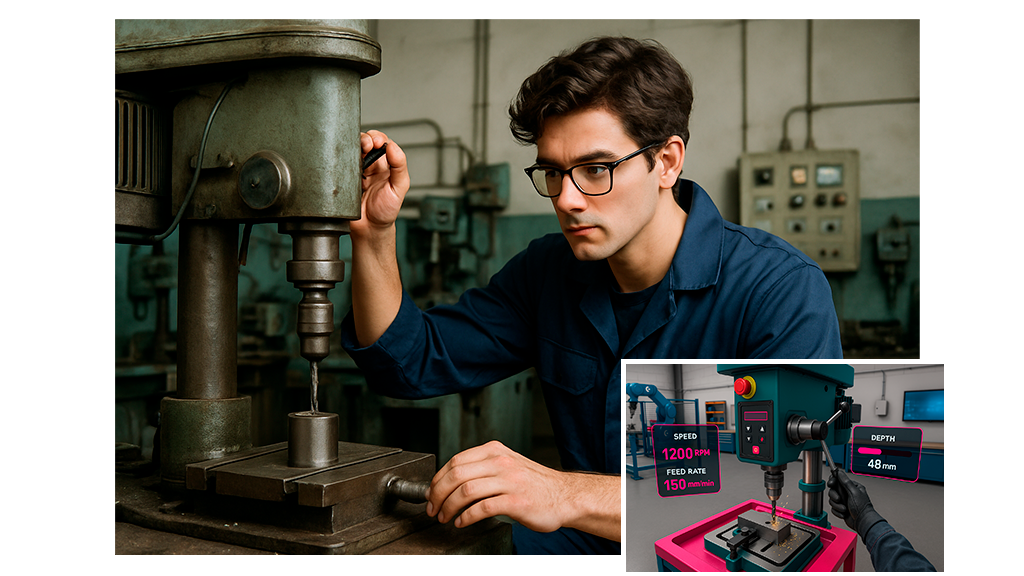
Furthermore, unlike physical equipment, which requires maintenance, storage space, spare parts and periodic renewal, virtual environments can be updated without structural costs and kept in line with the changing needs of the industry. This democratises access to the most advanced training and allows educational centres to keep pace with industrial reality without the need for disproportionate investments each time.
The cost of inaction
At the institutional level, European bodies responsible for monitoring the evolution of technical qualifications and labour market needs agree on the diagnosis: vocational training must evolve towards learning models that are more closely linked to the real productive environment.
More specifically, according to Cedefop, one of the leading authorities on the future of vocational training in Europe, the digitisation of training programmes is not an option, but a condition for ensuring the relevance of vocational education within the European economy. Failure to address this gap with a strategic and joint approach may limit the pace of alignment between training and the productive environment.
From a business perspective, having staff familiar with real procedures facilitates the integration of new tools and methodologies into their operations. At the same time, practical learning that is closer to the professional reality helps students enter the labour market with greater confidence and preparation.
And for society as a whole, moving towards training that is more aligned with the reality of the industrial environment means strengthening one of the essential drivers of productive and sustainable transformation. Having professionals familiar with real processes helps to boost key sectors such as advanced manufacturing, renewable energy and sustainable mobility, and promotes a solid, secure and competitive industrial transition.
The factory of the future must enter the classroom today
The gap between Industry 4.0 and vocational training is no longer a hypothesis: it is a tangible reality that is impacting companies, educational centres, workers and students. The good news is that there are solutions such as Virtual Reality that can bridge the gap, democratise access to advanced technical environments and prepare the talent of the future.
This technology is not intended to replace traditional practical training or experience with real machinery, but rather to complement it. Its function is to broaden access to real industrial scenarios that the educational centre cannot physically reproduce, becoming an ally of existing workshops, enhancing practical learning and raising the quality of training without relying on costly physical infrastructure.
But it is not enough to recognise its potential: action must be taken. The integration of these tools into vocational training programmes, teacher training, partnerships with technology companies and institutional support are essential elements in ensuring that technical training remains an effective route to quality jobs in an increasingly demanding and global market.
The factory of the future is already up and running. The question is whether we will be able to bring it into the classroom in time.